Nine ways people get nicotine pouches wrong
Most people who decide they dislike nicotine pouches were let down by a purchase or a habit rather than by the format. Nine specific mistakes — placement, timing, dose, storage — and the fix for each.

Nicotine Pouches Canada · Published · Reviewed · 9 min read
Prices, doses and pouch counts on this page are read from our own catalogue and from the per-can fact sheets we compile, as the shelf stood on the review date above. How we research and correct these pages.
Almost everyone who tries nicotine pouches and decides the format is not for them was let down by a decision made before the can was opened, or by a habit formed in the first twenty minutes after it was. The pouch itself is a very simple object. There are, however, about nine specific ways to get it wrong, and most people manage at least three of them on a first can.
None of what follows is difficult and none of it is a matter of taste. If you have already read how to use a nicotine pouch and it still is not working, the answer is almost certainly on this page.
First, what a pouch is actually doing
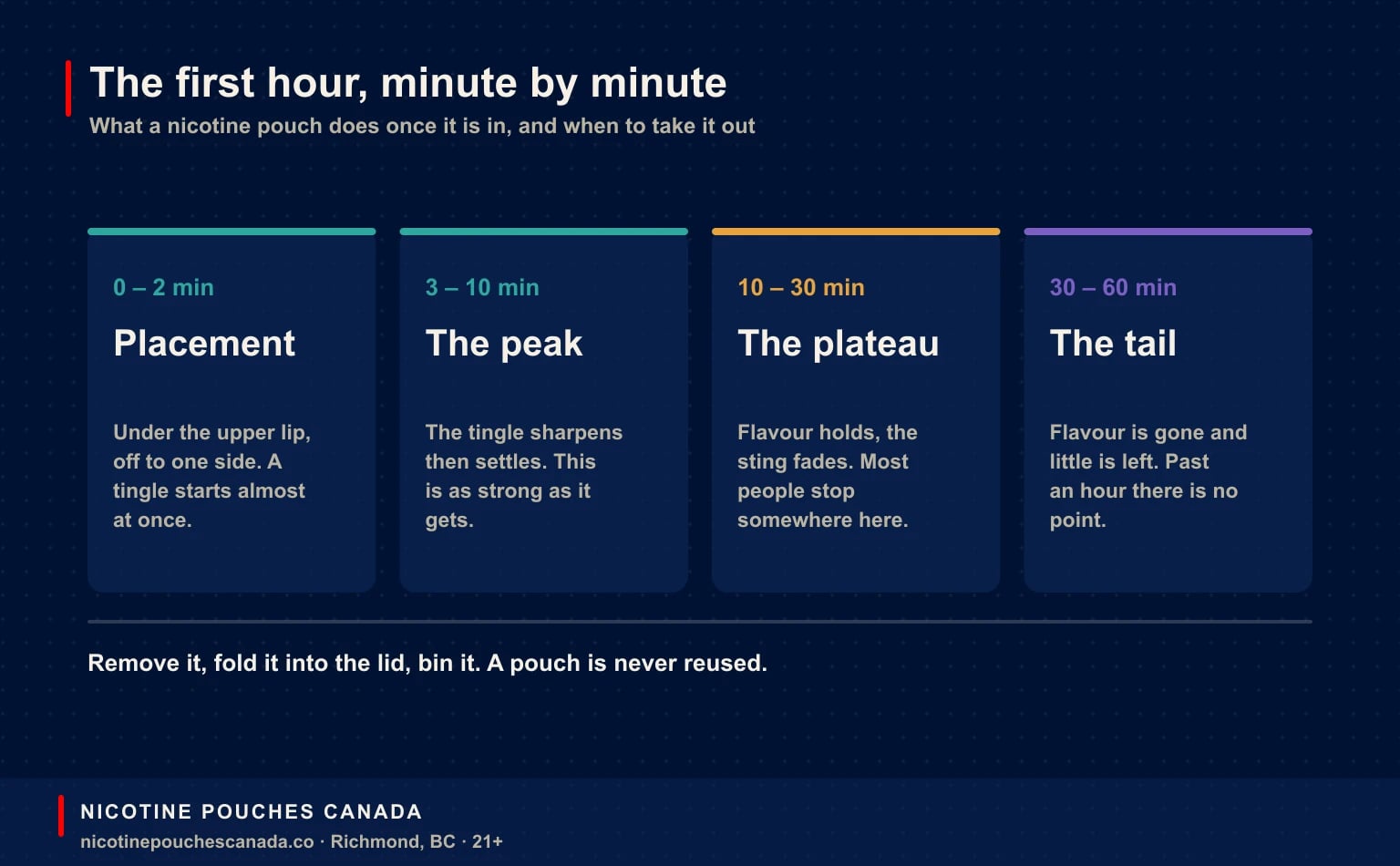
Half the mistakes below come from a mistaken model of the timing. A pouch is not a slow, even release across an hour — it front-loads, plateaus, and then has very little left. Knowing the shape of that curve tells you when to take it out, why the flavour goes before anything else does, and why adding a second one is answering the wrong question.
The nine
1. Starting at a strength built for someone else
This is the one that ends most people's relationship with the format inside a week, and it is almost always a purchasing decision rather than a technique problem. A can at 30 mg per pouch and a can at 4 mg look identical, cost roughly the same, and sit next to each other on the same shelf. Nothing about the packaging communicates that they are separated by a factor of seven.
A first pouch above roughly 6 mg does not read as "strong". It reads as a burn under the lip, a hot flush and an hour you would rather not repeat, and the flavour — which is the entire reason to prefer one can over another — is completely lost underneath it. You learn nothing except that you dislike pouches.
Start in the 3 to 6 mg band, spend a full can there, and step up only if the can is finishing without you noticing it. The strength chart sets out where every brand's bands actually fall, and they are not the same bands — one maker's "strong" is another's ordinary.
2. Putting it in the wrong place
A pouch goes between the upper lip and the gum, off to one side. Not the lower lip, not front and centre, and not tucked against the cheek. The upper lip has the tissue the format was designed around and, just as importantly, it is the one position where the pouch is out of the way of your teeth, your tongue and anything you are saying.
Front and centre is the commonest variation and the one that produces the most complaints. It puts the pouch where your tongue keeps finding it, where it is visible if you smile, and where the sensation concentrates in one narrow spot rather than spreading. Move it a centimetre to the left or right and a can that felt harsh often stops being.
3. Chewing it, sucking it, or moving it constantly
A pouch is not gum and it is not a lozenge. It works by sitting still against damp tissue, and everything you do to it beyond placing it makes the experience worse rather than faster. Chewing floods the whole thing at once, so the first two minutes are unpleasantly intense and the following twenty are flat. Sucking does the same in slow motion.
Moving it repeatedly is the subtler version. Every reposition restarts the process against tissue that is already saturated, which is how a perfectly reasonable 6 mg can ends up feeling like a 12 mg one by minute ten. Put it somewhere, leave it there, and let it do the work.
4. Leaving it in for an hour because the packet says you can
Most cans quote an upper limit rather than a recommendation, and the two get read as the same thing. In practice the useful part of a pouch is over well before the limit: the flavour peaks in the first ten minutes, holds through roughly the twentieth, and is essentially gone by the thirtieth. What remains after that is a damp object under your lip.
Twenty to thirty minutes is where most people land once they stop timing it against the packaging. If you are consistently reaching for a second one immediately after, the answer is a stronger can rather than a longer session — a pouch that has finished delivering does not start again because you leave it in.
5. Doubling up because the flavour faded
Flavour and strength are not the same system and they do not fade together. The flavouring is largely gone by twenty minutes; the rest is not. So the moment a can stops tasting of anything feels like the moment it stopped working, and the instinct is to add a second pouch — which does nothing at all for the flavour and a great deal for the dose.
If a can is losing its flavour faster than you would like, the fix is a different can. A cooling agent extends the perceived life of a mint noticeably, which is one reason mint, menthol and ice cans read as longer-lasting than fruit ones at the same strength. Two pouches at once is not a flavour solution wearing a different hat.
6. Judging a can on its first pouch
The first pouch out of a fresh can is the least representative one in it. The material has been sealed dry, the flavour sits unevenly across a full can, and your own reference point is whatever you had last — which, if that was a 12 mg mint, will make a 6 mg berry taste of almost nothing for about a day.
Give a can three or four pouches spread across two days before deciding. This is also the argument for buying one can of something new rather than three: at CA$12 to CA$14 a can, one is a cheap experiment and three is a commitment to a flavour you have met once.
7. Reading milligrams per pouch and ignoring milligrams per gram
The number printed largest on the front of a can is the total dose in one pouch. The number that predicts how it will feel is how concentrated that dose is in the material — milligrams per gram — and it is usually printed smaller or not at all.
Two 4 mg cans on our own shelf run 5.71 and 8 mg per gram. Same headline number, forty per cent apart on concentration, and they are noticeably different experiences: the denser one arrives faster and hits harder for the first ten minutes. When a can surprises you in either direction, this is very often why. The strength converter does the arithmetic between the two figures if you want to compare specific cans.
8. Storing the can badly, then blaming the brand
A can left in a car, on a windowsill or in a jacket pocket through a Canadian summer dries out from the inside. The pouches go stiff, the flavour flattens, and the whole can reads as a bad batch when it is a storage outcome. Heat is the main culprit; an unsealed lid is the second.
Keep the lid properly closed, keep cans somewhere cool and out of direct light, and use the older can first if you have several open. Some people refrigerate; it is not necessary, but it does no harm and it noticeably extends a can you are working through slowly. There is more on this in how to store nicotine pouches.
9. Having no plan for the used one
Every can made in the last few years has a compartment in the lid for exactly this, and a surprising number of people never find it. It is not a design flourish — it exists because the alternative is a used pouch in a pocket, a car door or a sink, and a pouch is not reusable under any circumstances.
Fold it into the lid, empty the lid into a bin, and keep the whole business out of reach of children and pets. That last part is not a formality: a used pouch still contains nicotine, and it is small, soft and exactly the sort of thing a dog will find interesting.
If a pouch is genuinely uncomfortable rather than merely strong, take it out. Nothing about the format requires you to sit through a can you are not enjoying, and the next one down the band will very likely be fine.
A short reference, by format
Format changes the timing as much as strength does, because a mini simply holds less material than a slim. If you are moving between formats, this is roughly what to expect before you start adjusting anything else.
| Format | Typical session | Flavour holds for | Best for |
|---|---|---|---|
| Mini | 15–25 minutes | Around 10 minutes | A first can, a discreet one, or a shorter break |
| Slim | 20–35 minutes | 15–20 minutes | The default. Most of the shelf is here |
| Large | 30–45 minutes | 20–25 minutes | An established habit that wants a longer session |
Session lengths are what most people settle on rather than a limit printed on a can. Individual experience varies considerably; the ordering between formats does not.
If you are unsure which format you have been buying, it is on every product page next to the dose. What a mini pouch is and slim versus regular both go into the difference in more depth, and the whole shelf is filterable by format at our nicotine pouch range.
Where exactly does a nicotine pouch go?
Between the upper lip and the gum, off to one side rather than front and centre. That position keeps it out of the way of your teeth and tongue and spreads the sensation instead of concentrating it in one spot. Moving a harsh-feeling pouch a centimetre sideways solves the problem surprisingly often.
How long should I keep a nicotine pouch in?
Twenty to thirty minutes suits most people. Cans quote an upper limit of around an hour, but that is a maximum rather than a recommendation, and there is very little left after half an hour. A mini fades sooner than a slim because it holds less material.
Why does my nicotine pouch burn?
Usually one of three things: the dose is higher than you are used to, the pouch is sitting front and centre rather than off to one side, or you have been moving it and restarting the process against tissue that is already saturated. Work through those in that order before concluding the brand is at fault.
Can I use two pouches at once?
You can, and it is almost always the wrong answer to the problem it is being used for. People reach for a second pouch when the flavour fades, and flavour fades long before anything else does — so the second pouch doubles the dose and does nothing for the taste. A different can is the fix.
Can you eat or drink with a pouch in?
Yes, though hot drinks in particular tend to accelerate the whole thing and can make a familiar can feel sharper than usual. We wrote that up separately in our piece on eating and drinking with a pouch in.
Do nicotine pouches go off?
They dry out rather than spoil, and heat is what does it. A can left in a car or on a windowsill goes stiff and flat and reads as a bad batch when it is a storage outcome. Keep the lid closed and the can cool and a range will taste the way it is meant to.
Can a pouch be reused?
No. Once it has been in, it is finished — fold it into the compartment in the lid and empty that into a bin. A used pouch still contains nicotine and must be kept away from children and pets.
What strength should I start on?
Three to six milligrams per pouch, in a mini or a slim. Spend a full can there before deciding anything. The single most common reason people write the format off is a first can built for a tolerance they have not developed yet.
Join the club
Subscribe for deals, fresh drops and pouch news — straight to your inbox.
⚠️ This page discusses products containing nicotine, an addictive chemical. For adult use only. Keep out of reach of children and pets.