Which nicotine pouch strength should you buy?
The milligram figure on the front of a can is the weaker of the two numbers printed on it. Four questions that settle which band you belong in, and the two mistakes people make on either side of the answer.

Nicotine Pouches Canada · Published · Reviewed · 8 min read
Prices, doses and pouch counts on this page are read from our own catalogue and from the per-can fact sheets we compile, as the shelf stood on the review date above. How we research and correct these pages.
There are 765 cans on our shelf that print a dose, and they run from 1.5 mg per pouch to 50. That is a factor of more than thirty between the lightest and the heaviest thing in the same category, sold in the same size tin, at close to the same price, with nothing on either package explaining that the gap exists.
So the question is not really "how strong are nicotine pouches". It is which of those bands you should be buying from, and that is a decision with four inputs. This page works through them in order. If you want the underlying definitions rather than the decision, nicotine pouch strengths, explained covers the terminology and the strength chart tabulates every brand we carry.
The two numbers on a can, and which one to believe
Milligrams per pouch is the total dose in one pouch. It is printed largest, it is what shops filter on, and it is the number everybody quotes. Milligrams per gram is how concentrated that dose is in the material the pouch is filled with. It is printed smaller, often not at all, and it is the better predictor of how a can will feel.
The reason is straightforward once stated. The dose does not arrive all at once; it arrives across a gradient, and concentration sets how steep that gradient is. A dense pouch delivers most of its payload in the first ten minutes and reads as sharp. A less concentrated pouch carrying the identical dose spreads it further and reads as mild — even though, half an hour later, the same amount has been delivered.
Two 4 mg cans on our own shelf run 5.71 and 8 mg per gram. Same headline figure, forty per cent apart on density, and genuinely different to use. When a can surprises you in either direction and the milligram number says it should not have, this is almost always the explanation. The strength converter will take one figure and give you the other if a listing only prints one.
A useful rule of thumb: milligrams per pouch tells you how long a pouch will keep working. Milligrams per gram tells you how hard the first ten minutes will be.
The six bands, and how many cans sit in each
Bands are a retail convention rather than a regulated scale, and every shop draws them slightly differently — which is why a can labelled "strong" by one maker can be lighter than another maker's "normal". These are the six we sort by, with the number of cans currently behind each. The distribution is worth a look on its own: the middle of the market is far larger than either end.
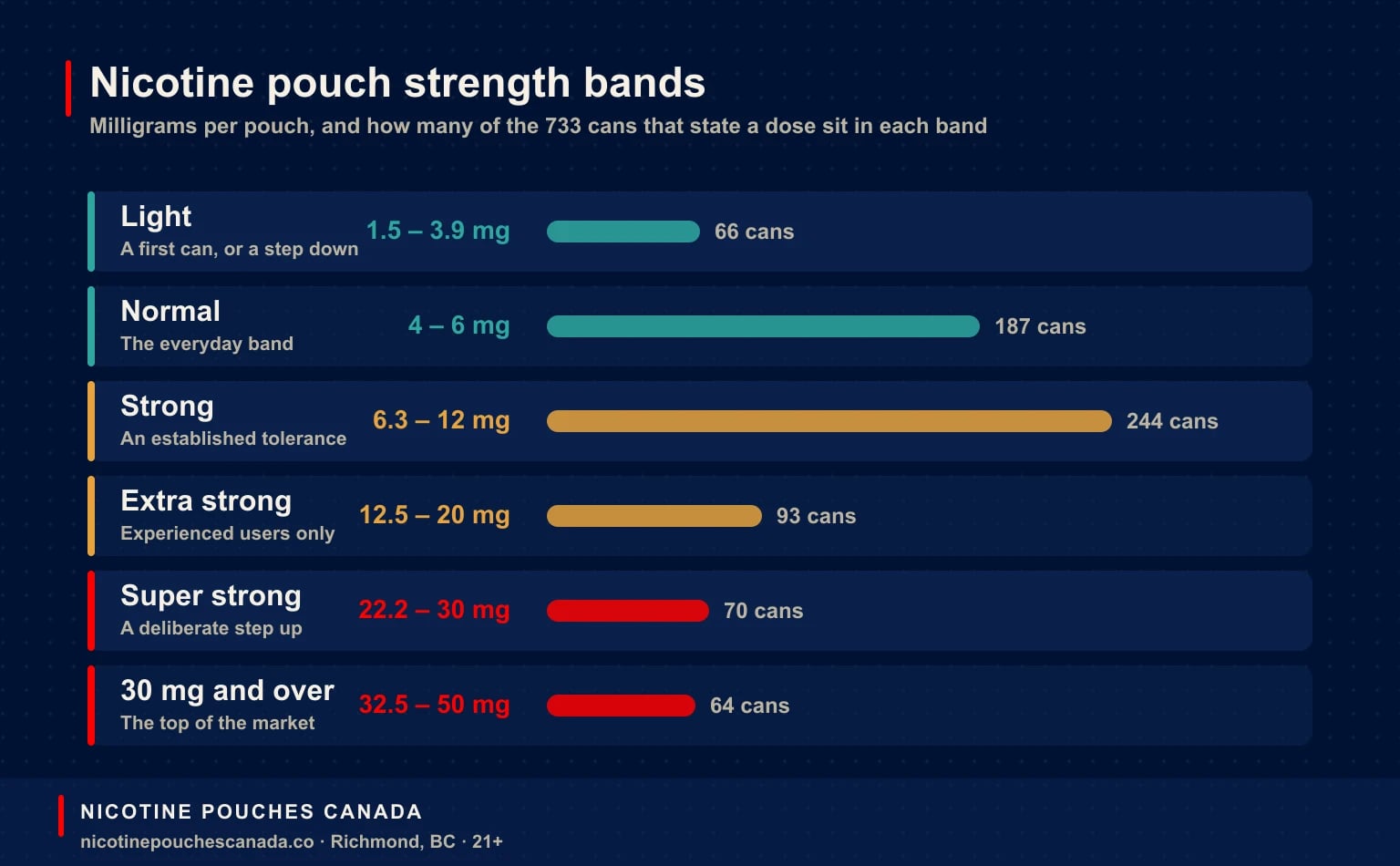
| Band | Per pouch | Cans | Who it is for |
|---|---|---|---|
| Light | 1.5–3.9 mg | 66 | A first can, or a deliberate step down from something heavier |
| Normal | 4–6 mg | 188 | The everyday band. Most people who use pouches regularly live here |
| Strong | 6.3–12 mg | 262 | An established tolerance, or a shorter session by choice |
| Extra Strong | 12.5–20 mg | 100 | Experienced users; this is where the first ten minutes get sharp |
| Super Strong | 22.2–30 mg | 70 | A deliberate step up, not somewhere to arrive by accident |
| Extreme | 32.5–50 mg | 70 | The top of the market. A specialist purchase |
9 cans on the shelf are nicotine-free — genuinely zero, not a low dose. A zero-dose can is never "Light": some packaging labels it that way because the label describes the format rather than the dose.
Four questions that settle it
1. What are you coming from?
This is the input that does most of the work, and it is the one the competing guides skip. Somebody who has never used nicotine in any form and somebody moving across from another product are not the same buyer, and giving them the same answer produces a bad first can for one of them.
If the answer is "nothing", start in the Light band and expect to stay there for at least a can. If the answer is another nicotine product used daily, Normal is usually the sensible landing point — Light will read as nothing at all, which is its own kind of failed experiment. 254 cans on our shelf sit at 6 mg or under, so neither of those answers narrows the choice much.
2. How long do you want a session to be?
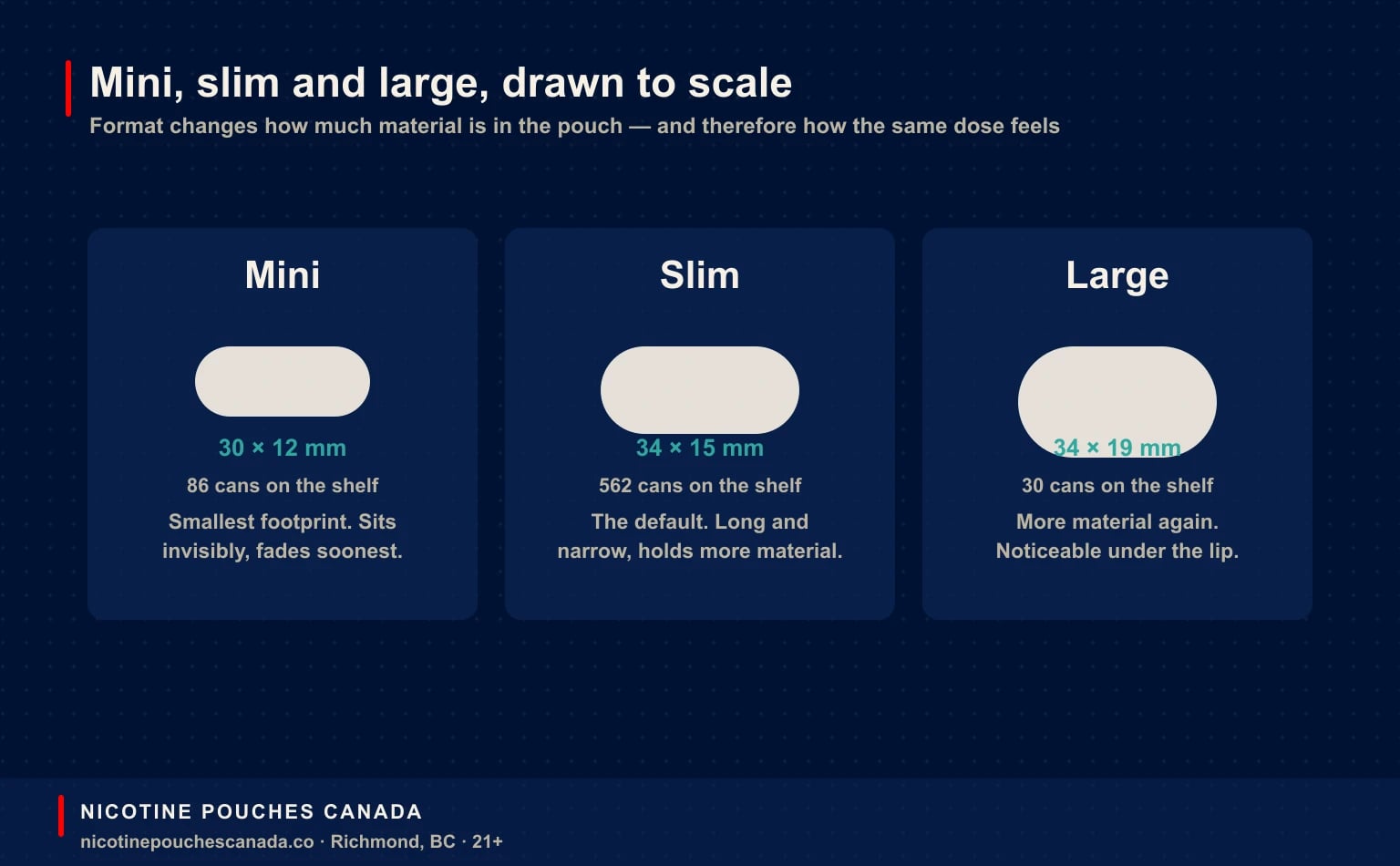
Format decides this more than dose does, and it changes the dose you should be buying. A mini holds noticeably less material than a slim, so it delivers faster, fades sooner and finishes in fifteen to twenty-five minutes. A slim runs twenty to thirty-five. A large runs longer again.
The practical consequence: the same milligram figure in a mini is a sharper experience than in a slim, because the same dose is packed into less material — which is milligrams per gram arriving through the back door. If you want short sessions, a mini one band down from your usual is generally closer than a mini at your usual number.
3. Do you want to taste it?
There is a genuine trade-off here that nobody advertises. Above roughly 12 mg per pouch, the sensation starts competing with the flavour for your attention, and above 20 mg it usually wins. Cans at the top of the market are not badly flavoured — they are well flavoured and you cannot really tell.
So if the reason you are buying a particular can is that you liked the sound of blackcurrant or cherry cola, that is an argument for staying in Normal or Strong rather than climbing. Our flavour guide works through which brands put their effort where, and most of the ones that take flavour seriously do their best work under 12 mg.
4. How often will you actually use one?
Two or three pouches a day and twelve pouches a day are different problems, and the second one is usually solved in the wrong direction. The instinct when a can is not lasting is to buy a stronger one; frequently the better answer is a longer-lasting format at the same dose, because what ran out was the session rather than the strength.
A twenty-count can at three a day is a week. At twelve a day it is under two days, and at CA$12 to CA$14 a can that arithmetic is worth doing before you decide the problem is the milligrams.
The short version, as a table
| If this is you | Start at | Format | Why |
|---|---|---|---|
| Never used nicotine in any form | 3–4 mg | Mini or slim | Leaves room to move up, and you will still taste the can |
| Used nicotine before, but not pouches | 4–6 mg | Slim | Light will read as nothing; Normal lands where you expect |
| Using pouches daily, want more from them | 6–12 mg | Slim | One band at a time. Two bands is where people overshoot |
| Established habit, want a shorter session | 12–20 mg | Mini | Less material and a higher concentration: same total, faster |
| Want the flavour to be the point | 4–10 mg | Slim | Above 12 mg the sensation starts drowning the flavour |
| Want the ritual without the nicotine | 0 mg | Slim | 9 nicotine-free cans, genuinely zero rather than low |
Stepping up without overshooting
The failure mode is predictable: a can stops being noticeable, the next purchase skips two bands, and the result is a tin of something unpleasant that sits in a drawer. Move one band at a time, and change one variable at a time — if you are also switching format or flavour family in the same purchase, you will not know which change did what.
It is also worth checking the concentration before assuming you need more milligrams. Moving from a 6 mg can at 8 mg per gram to a 6 mg can at 12 mg per gram is a real step up with no change to the number on the front, and it is a smaller one than jumping to 9 mg.
And stepping back down
Coming down is less discussed and just as common — usually because a strong can has stopped tasting of anything, or because the sessions have got longer than anyone wanted. The same rule applies in reverse: one band, one variable. A lighter can in a format you already know is a fair test; a lighter can in a format you have never tried is two experiments at once.
Whatever direction you are moving, the whole shelf is filterable by dose at our nicotine pouch range, and every listing prints the per-pouch figure and the per-gram figure where the can states one.
What strength nicotine pouch should a beginner buy?
Three to four milligrams per pouch, in a mini or a slim. That is low enough to leave somewhere to go and high enough to be a real experience rather than a blank one. Spend a full can there before changing anything.
Is 6 mg a strong nicotine pouch?
It sits at the top of the Normal band, so it is the everyday middle of the market rather than the strong end. Whether it feels strong depends heavily on the concentration behind it and on the format — a 6 mg mini is a noticeably sharper thing than a 6 mg slim.
What does mg per gram mean on a nicotine pouch?
How concentrated the dose is in the material, as opposed to how much of it there is in total. It sets how fast the pouch delivers, so it predicts the first ten minutes better than the per-pouch figure does. Two cans at the same milligram number can be forty per cent apart on this.
Why do two brands' 'strong' cans feel completely different?
Because the words are a shop convention rather than a regulated scale, and each maker draws its own lines. One maker's strong can be lighter than another's normal. Read the milligram figures on both cans and ignore the adjective — the strength chart lays out where every brand's bands actually fall.
Does the flavour change how strong a pouch feels?
Yes, and more than most people expect. Cooling agents register as intensity, so a heavily mentholated can reads as stronger than a fruit can carrying the identical dose. Moisture matters too: a damper pouch starts delivering sooner.
What is the strongest nicotine pouch available in Canada?
The highest labelled dose we carry is 50 mg per pouch. That is a specialist purchase rather than a step up from an ordinary strong can, and above about 20 mg the flavour of a can becomes very difficult to detect underneath the sensation.
Are there nicotine pouches with no nicotine?
Yes — 9 cans on our shelf are genuinely zero, not merely low. Worth knowing that a zero-dose can is sometimes labelled "Light" by its maker, because that word is describing the format rather than the dose. Zero is zero.
How do I know if a pouch is too strong for me?
If the first ten minutes are uncomfortable rather than merely noticeable, or you cannot taste the flavour you bought the can for, it is above your band. Take it out — nothing about the format requires finishing a pouch — and drop one band on the next purchase. Nausea and light-headedness ten to twenty minutes in are the clearest signals of all, and side effects and what causes each one sets out which of them a lower band actually fixes and which are about placement instead.
Join the club
Subscribe for deals, fresh drops and pouch news — straight to your inbox.
⚠️ This page discusses products containing nicotine, an addictive chemical. For adult use only. Keep out of reach of children and pets.