
Flagship report
The Canadian Nicotine Pouch Market Monitor 2026
Authorization, availability and enforcement
Published October 13, 2026 · version 1.0.0 · CC BY 4.0 · all underlying data downloadable
In short
- Health Canada’s product licence database contains 2 authorized nicotine pouch licences, held by 2 companies. Most published accounts still say there is one.
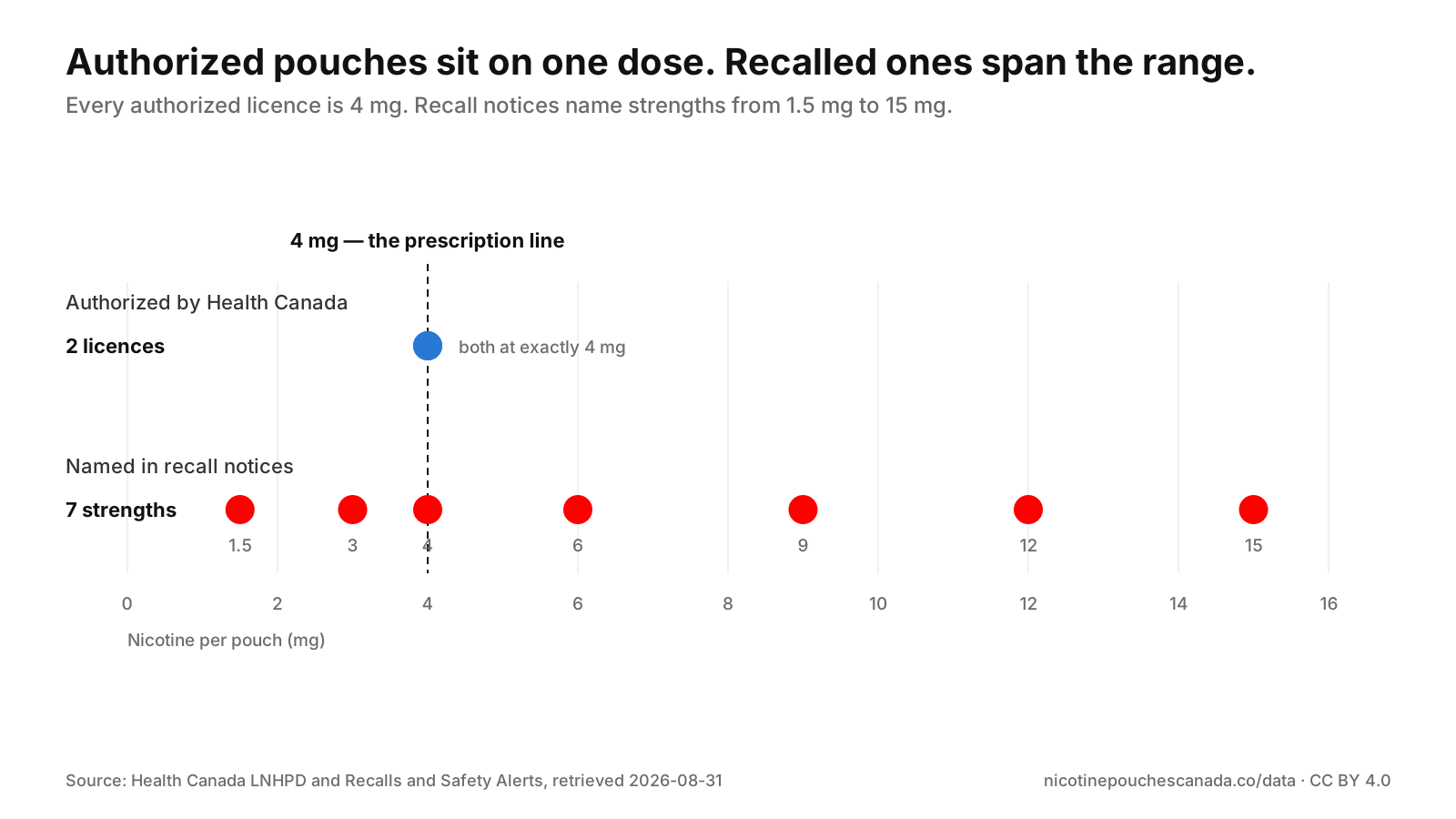
- Both sit at exactly 4 mg of nicotine per pouch. Not near it — on it.
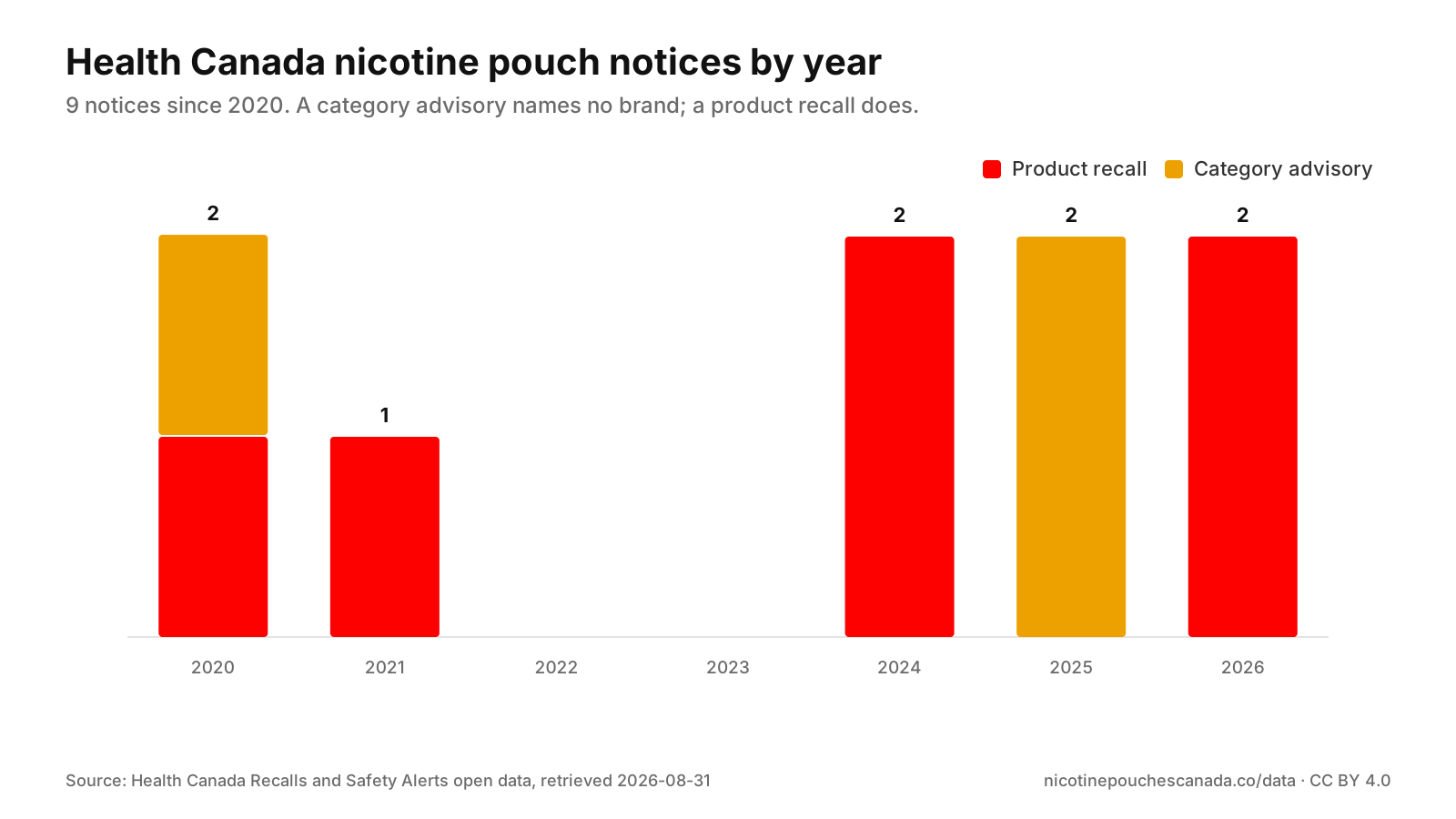
- There have been 9 Health Canada notices about nicotine pouches since 2020: 6 product recalls and 3 category advisories. Every one concerns market authorization, not a reported injury.
- Strengths named in those notices run from 1.5 mg to 15 mg — the top of that range is nearly four times the authorized dose.
- The most-quoted pharmacy figure in the country, 10,152 community pharmacies, excludes Quebec. The provincial column sums to 12,072.
Everything authorized is 4 mg. Everything recalled is not.
The clearest fact in the Canadian record is also the least reported one. Both authorized pouch licences — ZONNIC, licensed to Nicoventures Trading Limited in July 2023, and NEÖ, licensed to Swedish Smokeless Solutions AB in August 2025 — carry a medicinal ingredient record of 4 mg of nicotine per pouch. Both are authorized as nicotine replacement therapy for adults 18 and over, at up to 15 pouches a day.
That is not a coincidence of two products happening to land on the same dose. In January 2026 an amendment to the Prescription Drug List drew the line there explicitly: a buccal pouch containing 4 mg or less of nicotine per dosage unit is exempt from the list and may be regulated as a non-prescription natural health product, while anything above 4 mg is a prescription drug. The authorized market sits on the ceiling because the ceiling is what defines it.
Set that against what Health Canada has actioned. The recall notices name strengths of 1.5 mg, 3 mg, 4 mg, 6 mg, 9 mg, 12 mg and 15 mg. The July 2026 action — covering Supernova nicotine film and Supreme nicotine pouches, recalled by Supreme Trading Inc. of Burnaby, British Columbia, all lots, at retailer level — accounts for the top of that range on its own.
Embed this chart
Free to reuse with attribution under CC BY 4.0. Copy the snippet below — it loads the chart from here, so it stays current when the data is rebuilt.
<a href="https://nicotinepouchescanada.co/data"><img src="https://nicotinepouchescanada.co/images/data/authorized-vs-recalled-strengths.png" alt="Dot plot comparing authorized nicotine pouch strengths, both at 4 mg, against the 1.5 to 15 mg range named in Health Canada recall notices." width="1600" height="900" style="max-width:100%;height:auto"></a>
<p>Chart: <a href="https://nicotinepouchescanada.co/data">Nicotine Pouches Canada — Canadian Nicotine Pouch Market Monitor</a> (CC BY 4.0)</p>
Six years of enforcement, and what it is not about
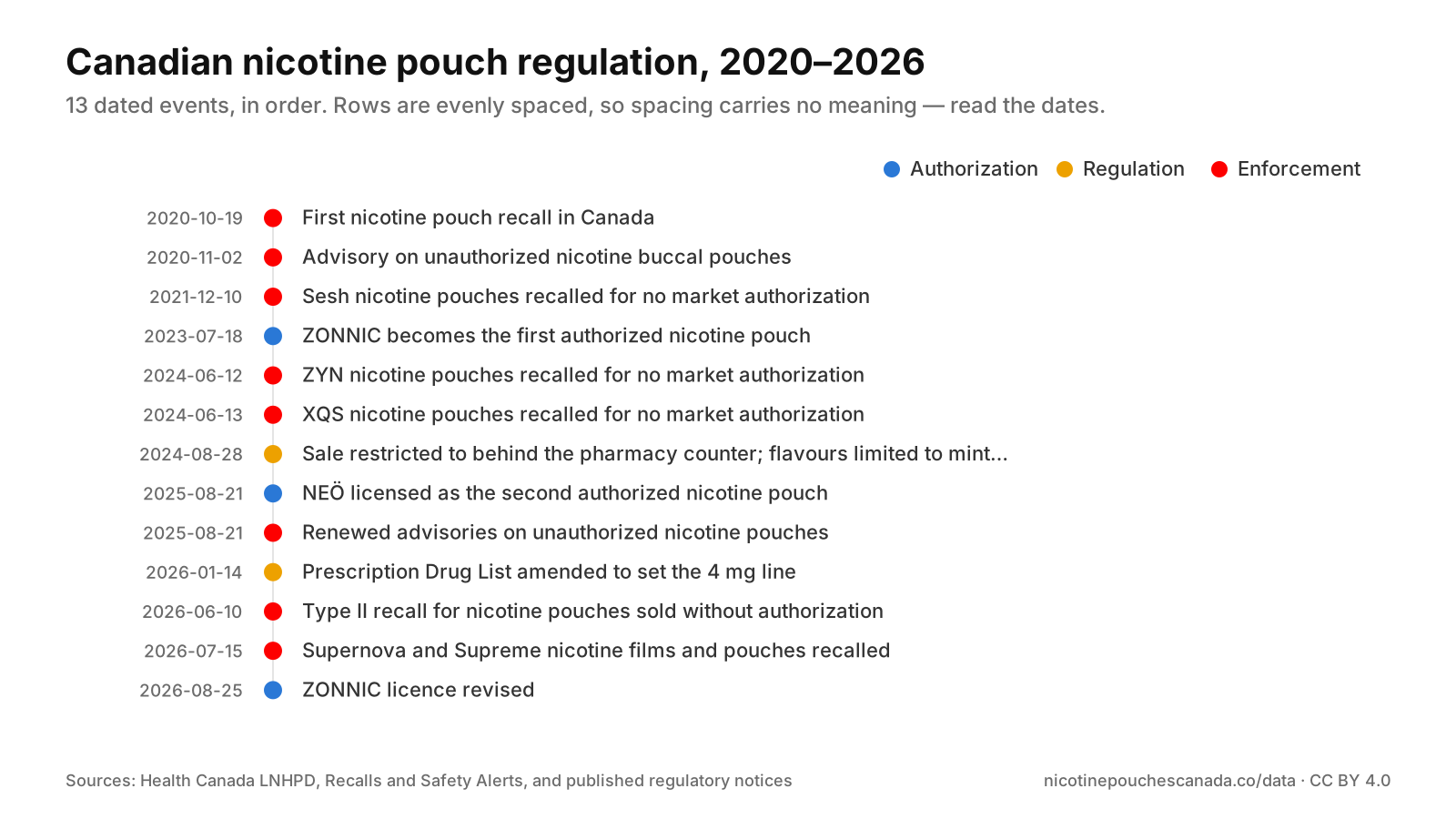
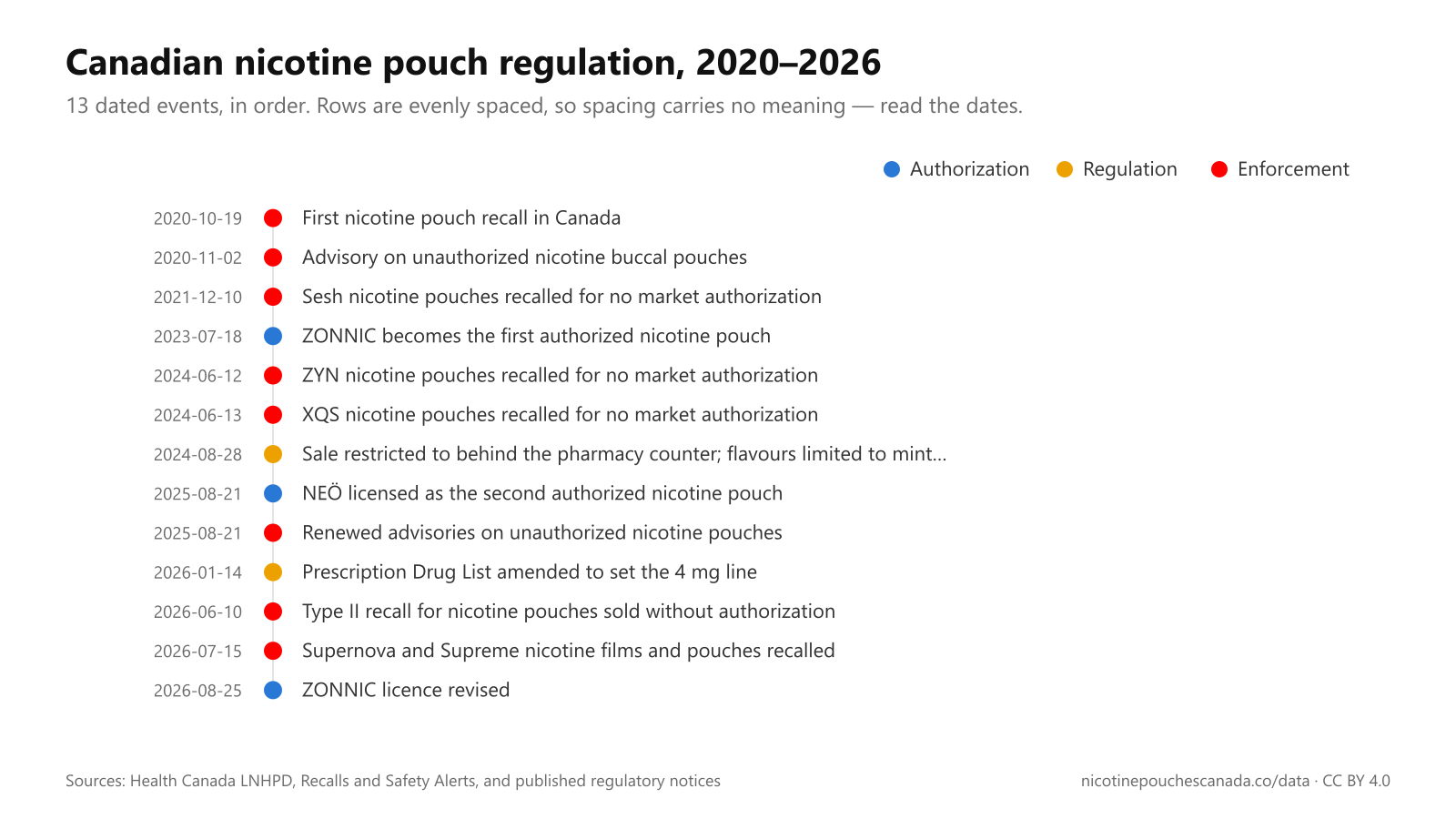
The first nicotine pouch notice on the Canadian record is a Type II recall of ZYN pouches in October 2020, followed two weeks later by a public advisory about unauthorized nicotine buccal pouches generally. Since then the pattern has been consistent and narrow: every one of the 9 notices concerns market authorization — a product sold without a DIN or NPN — rather than contamination, mislabelled content or a reported adverse event.
That distinction is worth holding onto, because “nicotine pouch recall” reads as a safety finding and these are regulatory findings. It also means the public record contains no Canadian count of harm from these products at all — which is the largest gap in this hub and is discussed below rather than papered over.
Embed this chart
Free to reuse with attribution under CC BY 4.0. Copy the snippet below — it loads the chart from here, so it stays current when the data is rebuilt.
<a href="https://nicotinepouchescanada.co/data"><img src="https://nicotinepouchescanada.co/images/data/recall-notices-by-year.png" alt="Stacked bar chart of Health Canada nicotine pouch notices per year from 2020 to 2026, split into product recalls and category advisories." width="1600" height="900" style="max-width:100%;height:auto"></a>
<p>Chart: <a href="https://nicotinepouchescanada.co/data">Nicotine Pouches Canada — Canadian Nicotine Pouch Market Monitor</a> (CC BY 4.0)</p>
Where an authorized pouch may legally be sold
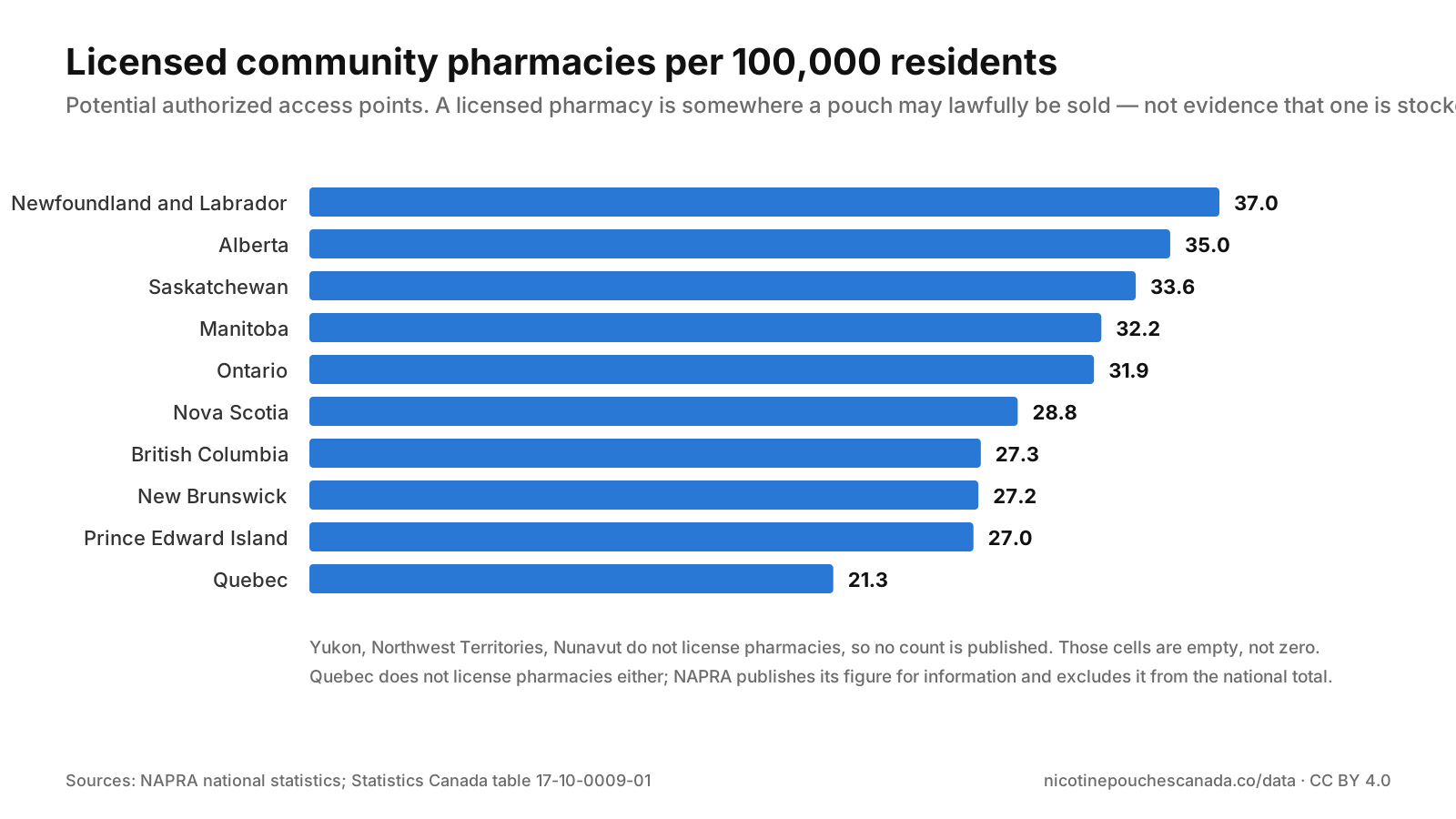
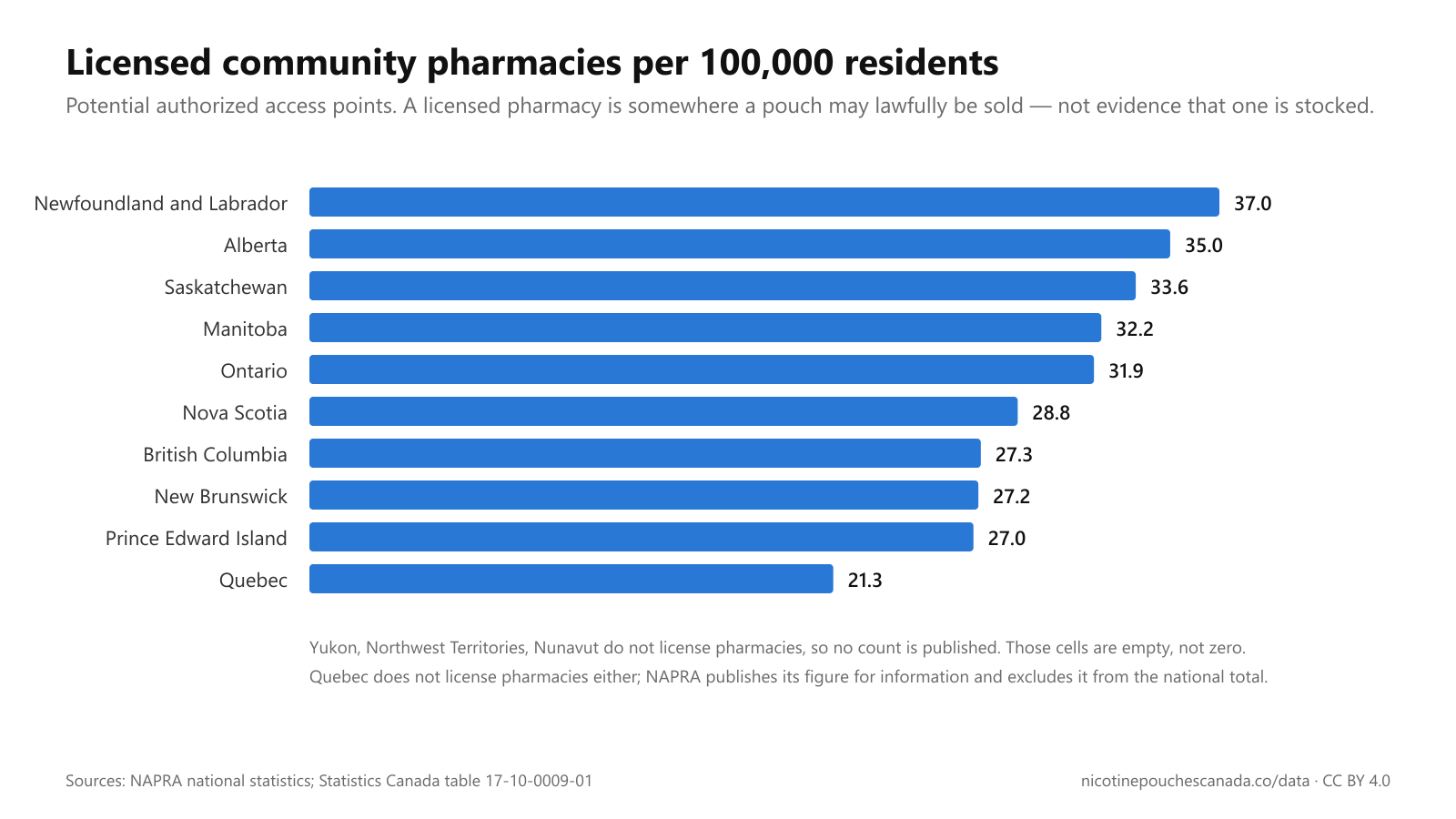
Since August 2024, authorized nicotine pouches may be sold only from behind a pharmacy counter, in mint or menthol only, with advertising restricted. That makes the pharmacy the unit of access, and it makes a simple question answerable: how many pharmacies are there, per person, in each part of the country?
Across the 10 jurisdictions that license pharmacies, the range is 21.2 to 36.7 community pharmacies per 100,000 residents. Newfoundland and Labrador is the densest; Quebec the least dense of those reported.
A caution about the national figure. NAPRA reports 10,152 community pharmacies in Canada, and that number circulates widely. NAPRA’s own footnote says Quebec is excluded from it, because Quebec — like Yukon, the Northwest Territories and Nunavut — does not license pharmacies through the reporting regulator. Add Quebec’s 1,920 back and the provincial column sums to 12,072. Neither figure is wrong; they answer different questions, and a story that cites the first while describing the second is off by about 16%.
Embed this chart
Free to reuse with attribution under CC BY 4.0. Copy the snippet below — it loads the chart from here, so it stays current when the data is rebuilt.
<a href="https://nicotinepouchescanada.co/data"><img src="https://nicotinepouchescanada.co/images/data/pharmacies-per-100k.png" alt="Horizontal bar chart of licensed community pharmacies per 100,000 residents for the ten Canadian provinces that license pharmacies." width="1600" height="900" style="max-width:100%;height:auto"></a>
<p>Chart: <a href="https://nicotinepouchescanada.co/data">Nicotine Pouches Canada — Canadian Nicotine Pouch Market Monitor</a> (CC BY 4.0)</p>
The regulatory record, in order
Embed this chart
Free to reuse with attribution under CC BY 4.0. Copy the snippet below — it loads the chart from here, so it stays current when the data is rebuilt.
<a href="https://nicotinepouchescanada.co/data"><img src="https://nicotinepouchescanada.co/images/data/regulatory-timeline.png" alt="Vertical timeline of thirteen Canadian nicotine pouch regulatory events from October 2020 to August 2026." width="1600" height="900" style="max-width:100%;height:auto"></a>
<p>Chart: <a href="https://nicotinepouchescanada.co/data">Nicotine Pouches Canada — Canadian Nicotine Pouch Market Monitor</a> (CC BY 4.0)</p>
What this data cannot tell you
The four most-asked questions about this category cannot be answered from any public feed, and this report does not answer them. Publishing an estimate in their place would produce figures that read exactly like observations, which is the failure the whole section is built to avoid.
- Authorized Pouch Price Index
No collection has run. Publishing a price index before the panel is defined and the first month is observed would put a number in circulation that nobody, including us, could reproduce.
- Pharmacy Stocking and Intervention Survey
No fieldwork has been carried out. The provincial table publishes the denominator only, because a pharmacy count is a fact and a stocking rate is a measurement.
- Canadian Online Market Compliance Audit
The audit instrument is drafted but no sample has been drawn. An audit whose sample frame is undocumented produces headline percentages that cannot be defended.
- Poison Exposure and Adverse Reaction Reports
No records have been requested or received. This is the dataset with the strongest public interest and the longest lead time; it is listed so the gap is visible rather than quietly absent.
The most consequential of these is the last. Health Canada’s notices record enforcement, not harm; there is no published Canadian count of nicotine pouch exposures by year, province or age group. Until poison centre and Canada Vigilance records are obtained, any claim about how often these products hurt anyone in Canada — in either direction — is unsupported by the public record.
Reuse, sources and corrections
Every figure in this report is derived at render time from the datasets in the data hub, each of which publishes its sources, its selector, its limitations and a CSV and JSON download. Our compilation is CC BY 4.0 — reuse it, including commercially, with attribution; the underlying government records carry their own terms.
Suggested citation: Nicotine Pouches Canada, “The Canadian Nicotine Pouch Market Monitor 2026,” version 1.0.0, October 13, 2026. If a figure here is wrong, email [email protected] and we will correct it on the page and say what changed.