
Provincial Pharmacy Access Denominators
Last updated October 13, 202613 rowsVersion 1.0.0Compiled by the Nicotine Pouches Canada editorial team
Population and licensed community pharmacy counts for all ten provinces and three territories, with pharmacies per 100,000 residents.
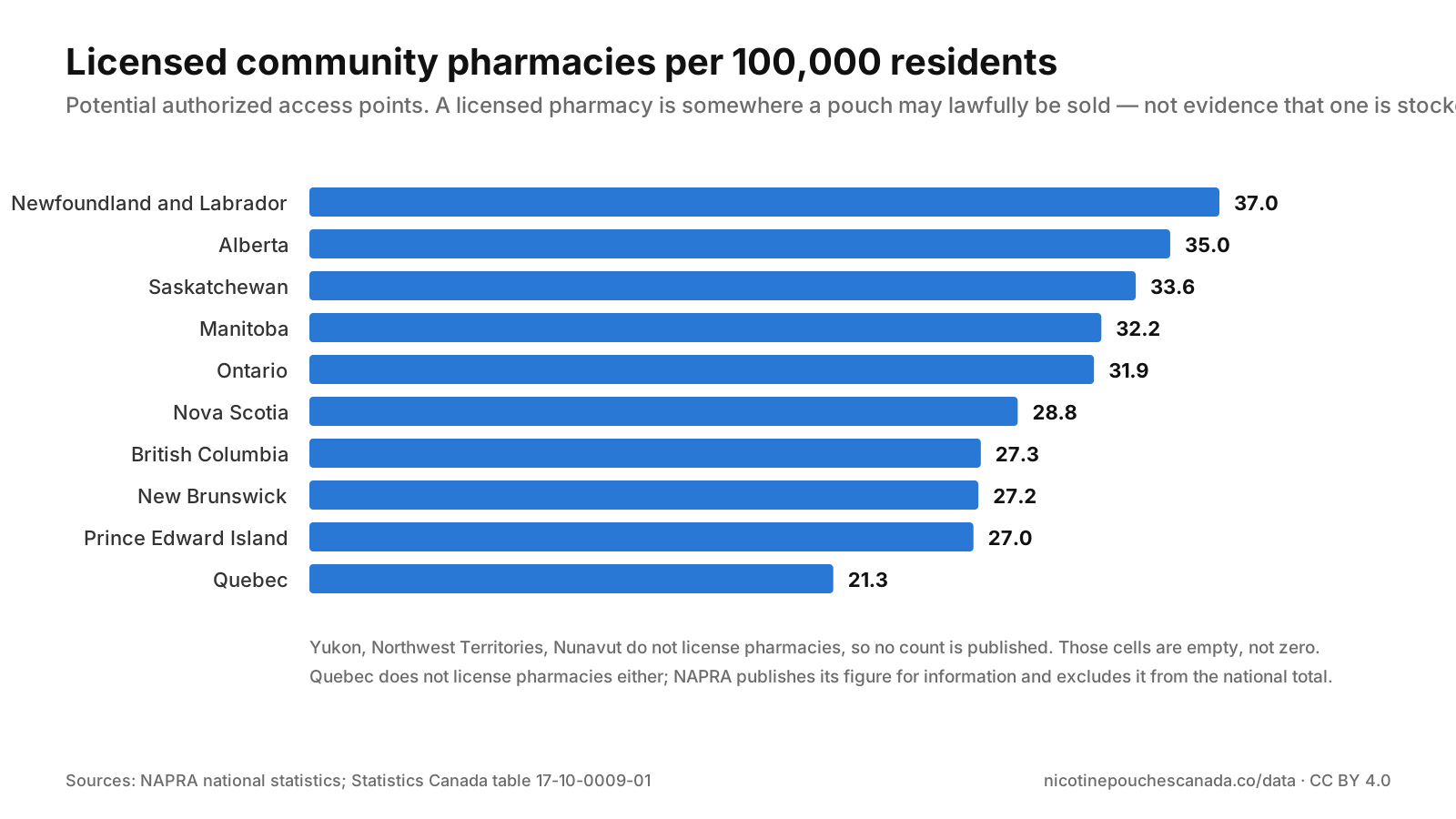
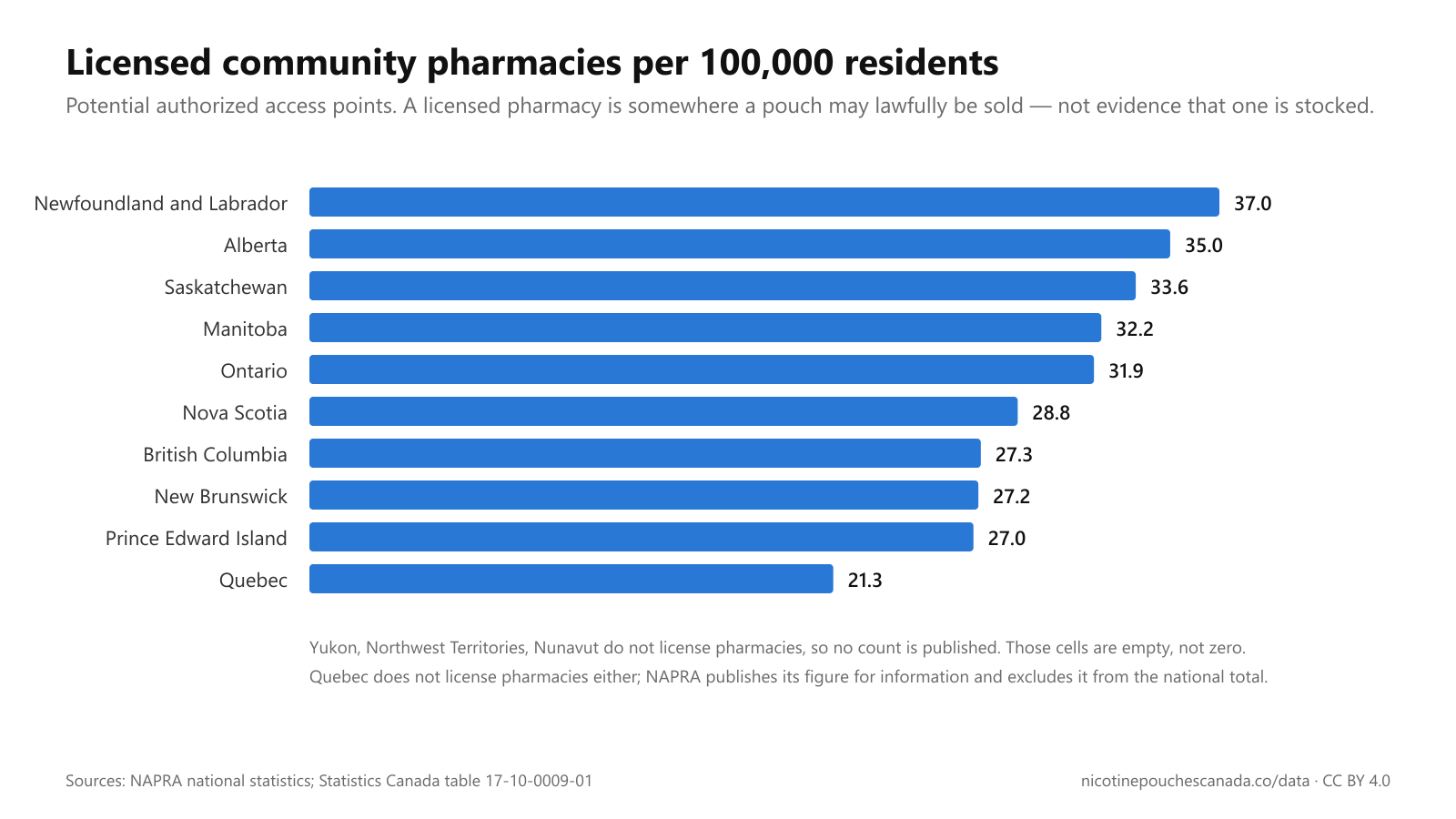
Embed this chart
Free to reuse with attribution under CC BY 4.0. Copy the snippet below — it loads the chart from here, so it stays current when the data is rebuilt.
<a href="https://nicotinepouchescanada.co/data"><img src="https://nicotinepouchescanada.co/images/data/pharmacies-per-100k.png" alt="Horizontal bar chart of licensed community pharmacies per 100,000 residents for the ten Canadian provinces that license pharmacies." width="1600" height="900" style="max-width:100%;height:auto"></a>
<p>Chart: <a href="https://nicotinepouchescanada.co/data">Nicotine Pouches Canada — Canadian Nicotine Pouch Market Monitor</a> (CC BY 4.0)</p>| Jurisdiction | Population | Community pharmacies | Per 100,000 | Note |
|---|---|---|---|---|
| Newfoundland and Labrador | 552,462 | 203 | 36.7 | |
| Prince Edward Island | 182,989 | 49 | 26.8 | |
| Nova Scotia | 1,103,419 | 314 | 28.5 | |
| New Brunswick | 883,522 | 236 | 26.7 | |
| Quebec | 9,067,114 | 1,920 | 21.2 | Quebec does not license pharmacies. NAPRA publishes this figure for information only and excludes it from the national total. |
| Ontario | 16,262,121 | 5,133 | 31.6 | |
| Manitoba | 1,517,379 | 484 | 31.9 | |
| Saskatchewan | 1,278,402 | 425 | 33.2 | |
| Alberta | 5,101,050 | 1,769 | 34.7 | |
| British Columbia | 5,710,598 | 1,539 | 26.9 | |
| Yukon | 50,356 | not published | — | This jurisdiction does not license pharmacies, so no count is published. |
| Northwest Territories | 45,904 | not published | — | This jurisdiction does not license pharmacies, so no count is published. |
| Nunavut | 43,091 | not published | — | This jurisdiction does not license pharmacies, so no count is published. |
The national total everyone quotes excludes Quebec. NAPRA reports 10,152 community pharmacies in Canada, and its own footnote says Quebec’s figure is published for information only and is not included in that total, because Quebec — like Yukon, the Northwest Territories and Nunavut — does not license pharmacies through the reporting regulator. Summing the provincial column gives 12,072, and the gap is exactly Quebec’s 1,920. Both numbers are correct; they answer different questions, and a story that cites one while describing the other will be wrong by 16%.
An empty cell is not a zero. The three territories publish no count, which is a fact about pharmacy regulation rather than about pharmacy access. Reading those blanks as zero would manufacture a finding about the least-served jurisdictions in the country.
Methodology, sources and limits
- What a row is
- All thirteen provinces and territories. Population is the latest quarterly StatCan estimate; pharmacy counts are NAPRA's most recent national compilation.
- Update cadence
- The upstream source changes annual. This page is as fresh as its last build, shown above — not as fresh as the source.
Sources
- Statistics Canada — Table 17-10-0009-01, Population estimates, quarterly — retrieved October 13, 2026. Statistics Canada Open Licence.
- NAPRA — National Statistics of Pharmacists, Pharmacy Technicians and Pharmacies — retrieved October 13, 2026. © NAPRA; counts reproduced with attribution.
Known limitations
- This measures potential access points, not access. A licensed community pharmacy is somewhere an authorized pouch may lawfully be sold; it is not evidence that any pouch is stocked there.
- Yukon, the Northwest Territories and Nunavut do not report a community pharmacy count to NAPRA. Those cells are empty, not zero.
- Quebec's figure carries a qualifier in the source and is reproduced with it.
- Population is total population, not adult population, so the per-capita figure is comparable between jurisdictions but is not a per-adult rate.
Licence and reuse
Our compilation — the selection, the joins, the derived columns and the charts — is published under CC BY 4.0. Reuse it, including commercially, with attribution. The underlying government records carry their own terms, named beside each source above; nothing here overrides them.
Suggested citation
Nicotine Pouches Canada. “Provincial Pharmacy Access Denominators.” Canadian Nicotine Pouch Market Monitor, version 1.0.0, October 13, 2026. https://nicotinepouchescanada.co/data/provincial-access
Corrections
If a figure here is wrong, tell us and we will fix it and say what changed. Email [email protected]. Corrections are recorded on the page rather than applied silently, because a dataset that changes without a note is one nobody can cite twice.